
On January 5th CSA Group published the first edition of particular requirements for rechargeable battery-operated commercial robotic floor treatment machines with traction drives. CSA 22.2 - 336 is a National Standard of Canada.
Why Should I Care?
If you are a robotics engineer working for a company planning to sell floor treatment machines in North America (including sweeping, scrubbing, wet or dry pickup, polishing, application of wax, sealing products, and powder-based detergents or shampooing) then this standard contains important test requirements for you.
Is it a Legal Requirement?
It is not.
Why Should I Care Then?
Occupational Safety and Health Act in the USA and the Canadian Electric Code are legal requirements. All electrically controlled devices or systems in the USA must be approved.
What is in the Standard?
Many of the requirements apply to both manual and robotic machines including such things like electrical safety, battery safety, mechanical strength and construction.
How Do I Get a Copy?
The standard is available from the CSA Group website at or by searching for “336-17” on the CSA Group Store. Please support them and consider licensing a copy of this document. The price is very reasonable at ~100 USD and the CSA do valuable work.
I’ve bought a copy CSA 336, it references 26 other standards do I have to buy all of those too and how much will that cost?
This table lists the standards directly referenced by CSA 336. In North American they are available for purchase from ANSI for approximately $10,000[1].
|
Standard |
Title |
|
NFPA 70 |
National Electrical Code |
|
UL 1012 |
Standard for Power Units Other Than Class 2 |
|
UL 1310 |
Standard for Class 2 Power Units |
|
UL 1564 |
Standard for Industrial Battery Chargers |
|
UL 2595 |
General requirements for battery-powered appliances |
|
UL 583 |
Standard for Electric-Battery-Powered Industrial Trucks |
|
IEC 60204-1 |
Safety of machinery – Electrical equipment of machines – Part 1: General requirements |
|
IEC 60335-1 |
Household and similar electrical appliances — Safety — Part 1: General requirements |
|
IEC 60335-2-29 |
Household and similar electrical appliances - Safety - Part 2-29: Particular requirements for battery chargers |
|
IEC 60335-2-69 |
Hazardous dust |
|
IEC 60335-2-72 |
Household and similar electrical appliances – Safety – Part 2-72: Particular requirements for floor treatment machines with or without traction drive, for commercial use |
|
IEC 60417 |
Graphical symbols for use on equipment |
[1] Prices checked January 2018
Functional Safety
Each of these standards refers to IEC 61508 Functional safety of electrical / electronic / programmable electronic safety-related systems. IEC 61508 is a multi-part standard that has requirements not only on the design but on the design process itself and the people conducting the engineering as well as the people checking or testing your work. IEC 61508 has requirements for both hardware and software.
I’m a systems engineer / architect where should I begin?
CSA 336 identifies six safety-critical functions and establishes the minimum safety integrity level required of the subsystems implementing these functions. It’s inevitable that automated machines like this will use a combination of hardware actuators and motors, programmable controllers and software, and sensors to implement these safety-critical functions. Here’s a diagram showing a typical scope for the safety functions. You’ll need design your own architecture and establish FIT targets for each of the elements in delivering the safety-critical functions and an overall system target.

I’m a hardware engineer what should I do?
Contact exida for books, training courses and world class experts to guide you through the complexities of functional safety and help you implement the right processes for your product and organization.
Consider buying a book and while you wait for that to arrive listen to the following webinars:
|
Webinar |
Presenter |
Title and Link |
Duration |
|
A solid introduction to functional safety and certification |
Dr. William Goble |
56 min |
|
|
For those familiar with an earlier edition of IEC 61508 |
Dr. William Goble |
66 min |
|
|
What you need in your development process to be compliant |
Michael Medoff |
Functional Safety: An IEC 61508 SIL 3 Compliant Development Process |
82 min |
I’m a software engineer what should I do?
exida has help for you. The 3rd edition of the IEC 61508 book has advice for software engineers. While you have that on order watch this webinar.
|
Webinar |
Presenter |
Title and Link |
Duration |
|
What you need to do to develop IEC 61508 compliant software |
Michael Medoff |
64 min |
It’s hard enough solving the robotics and providing the user interface features – are you going to make this even harder?
Look at our case studies and feedback from customers. In general, the most effective designs and most successful companies base their products around a well-designed safety architecture that gives them flexibility to provide excellent user features without compromising safety. exida specialize in helping you and demonstrating you have achieved world-class safety. We’ll help you make sure you get the right development process for your product and company.
Stopping distances and speed limits
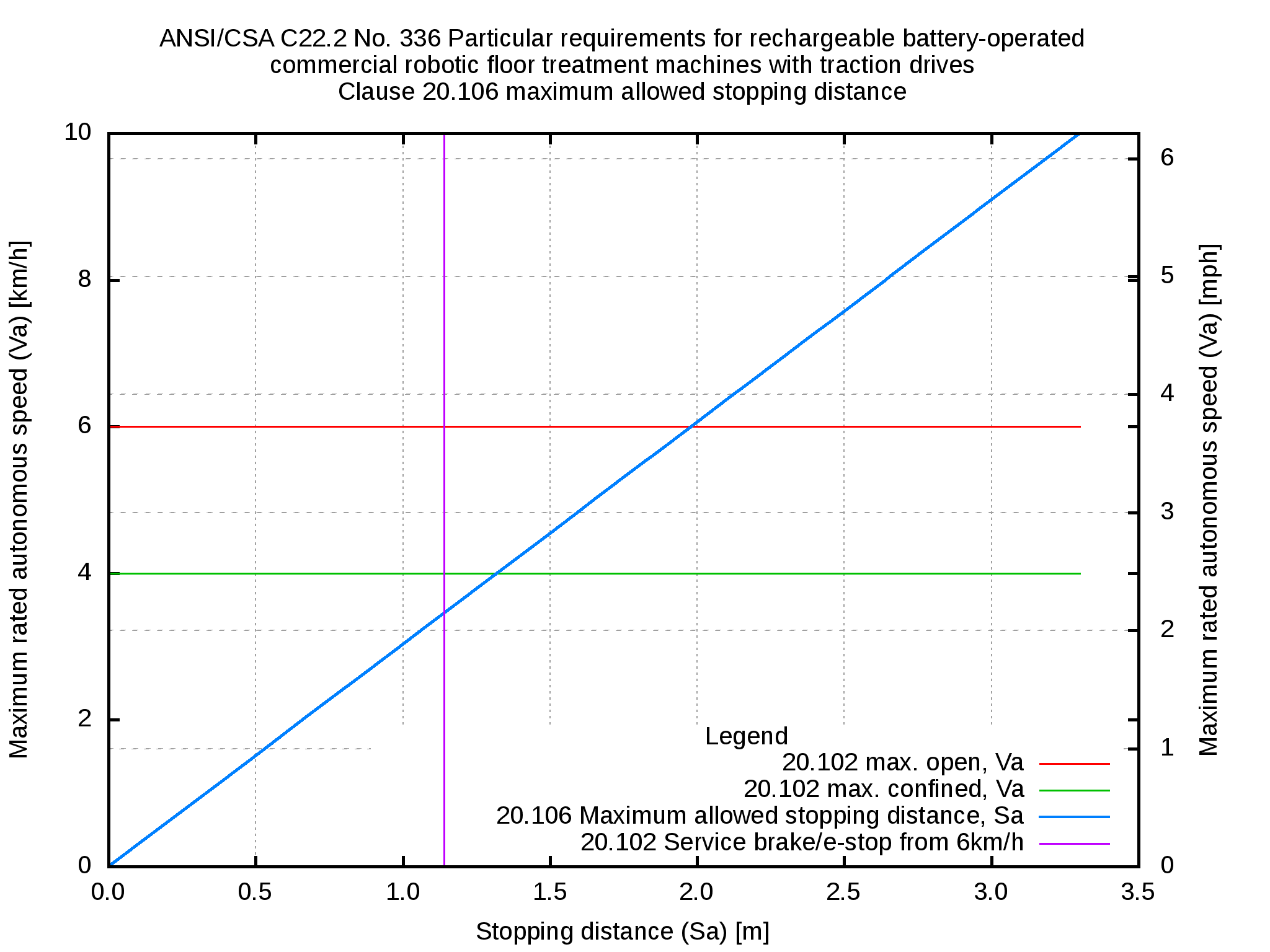
The various clauses relating to speed and stopping distance are summarized on the chart below. CSA 336 defines two regions of interest “open space” and “confined space”. The chart below shows the two speed limits and the speed dependent stopping distance while automated.
Method 2 proposed at IEC SJ61J meeting at VDMA in Frankfurt February 15, 2018
To calculate the distance Sa two methods have been examined. Source data for these data are shown below using the calculation in CSA 336-17 and a proposed alternative method taking care to ensure the units used in the equations are balanced. Converting speed from km/h into m/s and then using a different factor 0.33 to 1.184 makes no difference to the maximum allowable stopping distance.

The conversion from km/h into m/s is as follows:

Obstacle detection
Without referring to ANSI B56.5 Safety Standard for Driverless, Automatic Guided Industrial Vehicles and Automated Functions of Manned Industrial Vehicles CSA 336 defines two test obstacles that are very similar to the Test Pieces specified in section 8.11.1.2.1. ANSI B56.5 is available free of charge from the Industrial Truck Standards Development Foundation after free registration. Clause 20.107 of CSA specifies the requirements for detecting these test obstacles. Clause 20.108 defines requirements for dealing with edges. Requirements for stopping due to obstacles are specified in clauses 20.111, 20.112 and 20.113.
Starting, restarting and resetting
Clauses 20.101, 20.110 and 20.111 have requirements for switch off, initial start-up and restarting after stopping or contacting obstacles. These functions are all defined as safety-critical functions so subject to achieving the minimum safety integrity levels for functional safety.
External links (valid January 2018)
|
# |
Reference |
Link |
|
1 |
CSA/ANSI C22.2 NO. 336-17 - Particular requirements for rechargeable battery-operated commercial robotic floor treatment machines with traction drives |
http://shop.csa.ca/en/canada/appliances/csaansi-c222-no-336-17/invt/27043752017 |
|
2 |
CSA Group Store |
|
|
3 |
ANSI/ITSDF B56.5 - 2012, Safety Standard for Driverless, Automatic Guided Industrial Vehicles and Automated Functions of Manned Industrial Vehicles EFFECTIVE 03/01/13 |
http://www.itsdf.org/forms/regusers/standards/12_ITSDF-B56-5-2012-rev-03-07-14.pdf |