- by Loren Stewart, CFSE
- Tuesday, May 21, 2019
- Functional Safety
Back to Basics 08 – IEC 61511
IEC 61511: 2016 Process Industry Sector
IEC 61511 is a technical standard that sets out practices in the engineering of systems that ensure the safety of an industrial process through the use of instrumentation. It entails requirements for users of process control and instrumentation for component / element or sub-system safety.…
Read More...
- by Loren Stewart, CFSE
- Tuesday, June 11, 2019
- Functional Safety
Back to Basics 10 – How Does a Product Get a SIL?
IEC 61508 functional safety standard indicates Safety Integrity Levels (SIL) needs to be evaluated by three design barriers:
- The Systematic Capability Rating
- The Architectural Constraints for the Element
- The Probability of Failure for the Product

Systematic Capability is achieved when the equipment…
Read More...
- by Loren Stewart, CFSE
- Wednesday, June 26, 2019
- Functional Safety
Back to Basics 11 – How is SIL Used by an End User?
IEC 61508 and IEC 61511 functional safety standards allow Safety Integrity Levels (SIL) to be used four ways by end users:
- To establish risk reduction requirements - How much risk needs/can be removed from the process to achieve a tolerable risk level? (For more…
Read More...
- by Loren Stewart, CFSE
- Tuesday, August 13, 2019
- Functional Safety
Back to Basics 13 - How Do I Start IEC 61508 Certification?
Do you want to know more about IEC 61508 certification, but you’re not sure if you are ready to jump in? Don’t worry, we will make this process as painless as possible.
Here is what to expect:
- Introduce Scope
- Kickoff Meeting
- Perform FMEDA on Product
- Creation of…
Read More...
- by Loren Stewart, CFSE
- Thursday, September 05, 2019
- Functional Safety
Back to Basics 14 - Systematic Capability
Systematic Capability is achieved when the equipment used to implement any safety function achieves two goals: the design process has used procedures intended to prevent systematic design errors (fault avoidance) and the design has systematic design control mechanisms such as a diagnostic for incorrect software execution (fault control). The rigor…
Read More...
- by Loren Stewart, CFSE
- Thursday, October 03, 2019
- Functional Safety
Back to Basics 15 - Architectural Constraints
Architectural constraints are limitations that are imposed on the hardware selected to implement a safety-instrumented function, regardless of the performance calculated for a subsystem. Architectural constraints are specified (in) according to the required of the subsystem, type of components used, and of the subsystem’s components. (Type A components are simple devices…
Read More...
- by Loren Stewart, CFSE
- Thursday, October 31, 2019
- Functional Safety
Back to Basics 16 - PFDavg
PFDavg (the average Probability of Failure on Demand) is the probability that a system will fail dangerously, and not be able to perform its safety function when required. PFDavg can be determined as an average probability or maximum probability over a time period. IEC 61508 and IEC…
Read More...
- by Loren Stewart, CFSE
- Tuesday, November 19, 2019
- Functional Safety
Back to Basics 17 - PFH (Probability of dangerous Failure per Hour)
PFH (Probability of dangerous Failure per Hour) is the probability that a system will fail dangerously, and not be able to perform its safety function when required. PFH can be determined as a probability or maximum probability over a time period of an hour. IEC 61508 and Read More...
- by Loren Stewart, CFSE
- Tuesday, February 25, 2020
- Functional Safety
Back to Basics: Failure Rates
Failure rates are the number of failures per unit time for a piece of equipment which are usually assumed to be a constant value. They can be broken down into several categories, such as safe and dangerous, detected and undetected, and independent/normal and common cause. Failure rates are often…
Read More...
- by Loren Stewart, CFSE
- Thursday, March 05, 2020
- Functional Safety
Back to Basics: Failure Rates - FIT
Failures In Time or Failure UnIT
FIT is the number of failures per billion hours for a piece of equipment.
It is mentioned in both IEC 61508 and IEC 61511 standards as a preferred unit of measurement expressed by 109 hours.
Example: 5 FIT is expressed as 5 failures within 109 hours .
When you…
Read More...
- by Loren Stewart, CFSE
- Thursday, March 19, 2020
- Functional Safety
Back to Basics: Failure Rates - λ
The Greek symbol lambda, λ, represents failure rates in functional safety, usually expressed in the unit of measurement of FITS.
λ can be expressed as a total failure rate for a device (λT), or it can be broken down into more specific groupings:
- by Loren Stewart, CFSE
- Thursday, April 02, 2020
- Functional Safety
Back to Basics: Failure Rates - λD
The Greek symbol λD represents dangerous failure rates in functional safety, usually expressed in the unit of measurement of FITs, and can be determined through FMEDAs. (FITs (λ) are failures per billion hours, expressed by 10-9 hours).

λD is the number of dangerous failures per…
Read More...
- by Loren Stewart, CFSE
- Tuesday, June 30, 2020
- Functional Safety
Back to Basics: Failure Rates - λDD
The Greek symbol λDD is the detectable dangerous failure rate in functional safety expressed in the unit of measurement of FITs which can be determined through FMEDAs. (FITs (λ) are failures per billion hours, expressed by 10-9 hours).

λDD is the number of…
Read More...
- by Loren Stewart, CFSE
- Thursday, June 04, 2020
- Functional Safety
Back to Basics: Failure Rates - λDU
The Greek symbol λDU is the undetectable dangerous failure rate in functional safety expressed in the unit of measurement of FITs which can be determined through FMEDAs. (FITs (λ) are failures per billion hours, expressed by 10-9 hours).

λDU is the number of dangerous undetected failures…
Read More...
- by Loren Stewart, CFSE
- Tuesday, August 18, 2020
- Functional Safety
Back to Basics: Failure Rates - λS
The Greek symbol λS represents safe or spurious failure rates in functional safety expressed in the unit of measurement of FITs which can be determined through FMEDAs. (FITs (λ) are failures per billion hours, expressed by 10-9 hours).

λS is the number of safe…
Read More...
- by John Yozallinas, CFSE
- Thursday, July 30, 2015
- Certification
Building a Foundation for an IEC 61508 Development Process
There are organizations that are small enough to follow an informal or even undocumented process and still produce a product of sufficient quality to meet market needs. When these organizations attempt to develop a safety product, they inevitably fall short of meeting the requirements of IEC 61508. A formalized…
Read More...
- by Dr. William Goble, CFSE
- Thursday, May 12, 2011
- Certification
Buy Certified Equipment, Meet the Standard, Right? WRONG!
While correcting a CFSP exam, I read a question which went something like this:
If you purchase all IEC 61508 certified equipment for a low demand safety instrumented function, then to meet the requirements of IEC 61511:
A. No other design verification is needed
B.…
Read More...
- by Dr. William Goble, CFSE
- Thursday, May 09, 2013
- Certification
Certificate Forgery!
exida has discovered yet another forged functional safety certificate. You can read about another occurrence in a previous blog entry.
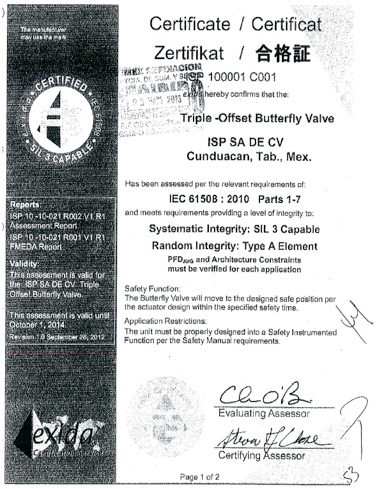
The company name on the forged certificate is ISP SA DE CV, Cunduacan, Tab., Mex. How could someone…
Read More...
- by John Yozallinas, CFSE
- Tuesday, August 18, 2015
- Certification
Certification and the Environmental Test
Functional Safety Assessments (FSA) focus on the relevant functional safety standards that are to be applied to a product in the appropriate industry. These are standards such as IEC 61511 in the process automation industry, or ISO 26262 in the automotive industry. And IEC 61508 is like an umbrella…
Read More...
- by Dr. William Goble, CFSE
- Thursday, April 07, 2011
- Functional Safety
Certified to SIL 4 - Cycle Test Failure Data is Dangerous
I got a copy of the IEC 61508 certificate for a solenoid valve today from an engineer who thought something was wrong. Although the certificate was from a well known certification company, the certificate gave a “Dangerous Failure Rate” of 1.7 FITS (1.7 * 10-9 failures per…
Read More...


